
Alexander Turner
A Visit to Highgrove Orchard
Back in mid-September Avon Need Trees were kindly invited to the private orchard of His Majesty The King at Highgrove House and Gardens. Our Land and Habitat […]

16th February 2026
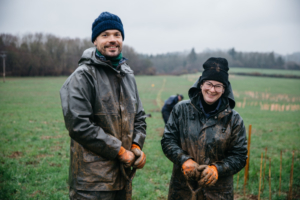
“If I came to you and said: ‘I’ve invented a new kind of fencing- it’s cheap, low maintenance, improves soil structure, stores carbon, shelters livestock, reduces flooding, soil erosion, prevents wind damage and massively boosts biodiversity on the smallest possible footprint,’ it would sound too good to be true,” says Sam Martlew.
He pauses, then smiles. “But that’s just a hedgerow.”
Sam Martlew is part of a growing movement in the nature community that believes one of the most unremarkable features of the British countryside – the humble hedgerow – might just be one of the UK’s most powerful tools for ecological repair. As climate pressures mount and biodiversity continues to decline, conservationists are increasingly pointing back to this ancient infrastructure as part of the solution.
Sam, along with his colleague Gemma Michael, are standing in a muddy field between Bristol and Bath planting mile after mile of new hedgerow. They are part of planting efforts to transform this 422 acre former farm into Lower Chew Forest – a mosaic habitat of 100,000 new trees, wetland, rolling grasslands and of course, hedgerows.
They and the volunteers they are coordinating couldn’t be happier about it. The volunteer’s spades plunge into the earth with an urgency that supports Michael’s conviction that “hedgerows are our biggest manmade habitat when you add them together across the country. They’ve been part of our landscape for centuries, shaped by people, and in the process they’ve become extraordinary habitats.”
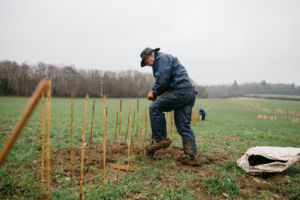
Both Michael and Martlew work on hedgerow restoration for the countryside charity Campaign to Protect Rural England (CPRE). The charity’s ‘Hedgerow Heroes’ project was launched 5 years ago to combat the worrying trends that have developed over the last century which show that hedgerows have been steadily disappearing from the landscape. The Woodland Trust estimates that since 1950, the UK has lost around 118,000 miles of this precious habitat.
The disappearance of hedgerows stems mainly from agriculture. As farms became bigger, mechanisation and post-war agricultural intensification has seen many hedgerows grubbed out to make way for larger fields and faster farming. The consequences are now visible in degraded soils, increased flooding, fragmented habitats and collapsing wildlife populations.
According to experts such as the Tree Council, what hedgerows offer is connectivity. They are an invaluable resource for much of the UK’s beleaguered wildlife, offering safe passage for animals to move, rest and feed. Dormice, which live in trees and avoid the ground, use hedgerows as corridors between woodlands. Bats navigate along them at night, following their linear shape like living signposts. Birds flit from hedge to hedge to cross open fields without exposing themselves to predators. Even plants, lichens and fungi have evolved to live in the unique microclimate of hedgerows, forming a community found nowhere else.
“There was a study that found more than 2,070 species in an 80 metre stretch of hedgerow,” Michael says. “That gives you a sense of how dense these habitats are. When you remove a hedgerow, you’re not just taking away a boundary. You’re wiping out a whole living system.”
Hedgerows also perform an underground, less visible labour. Their roots stabilise soil and reduce erosion. Their structure slows rainwater as it moves downhill, helping to prevent flooding and reducing the nitrogen runoff that pollutes rivers. “They’re like natural land dams,” Gemma explains. “They slow water down, give it time to soak in, and stop soil being washed away.”
It’s for these reasons that Avon Needs Trees, the charity behind Lower Chew Forest, are so keen to reintroduce hedgerows to the landscape. “What we’re doing here is establishing a vital green space with as broad a mix of habitats as possible. Nature thrives in these edge spaces, which is why we are planting 3.7km of hedge across the site – linking up woodland and reintroducing some of that natural resilience to the landscape,” says Alister Wynn, Head of Woodlands and Impact for the charity.
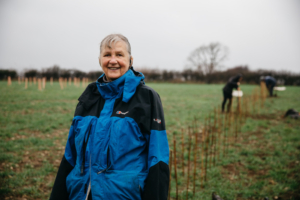
A key mission for Avon Needs Trees is to get people back out into the landscape to rediscover lost skills and celebrate the region’s unique rural heritage. That’s why many of the trees they will plant this season will be by the hands of their 2,000 volunteers who come out to plant trees, lay hedges and even learn lost skills like scything.
For Martlew, hedgerows offer a lesson all in themselves: that humans can work with nature rather than against it. “We’re always looking for new systems and technologies to fix environmental problems,” he says. “But hedgerows are ancestral knowledge. They’re proof that we already know how to build systems that work with the natural world. We just stopped paying attention.”
For many of the volunteers, part of the hedgerow revival now taking place is cultural. Traditional hedge laying – the skilled practice of partially cutting and bending shrubs to create dense, living barriers – fell into decline with the hedges themselves as maintenance became increasingly mechanised. But volunteers like the ones here today are relearning these skills. “There’s a real hunger for it,” Michael says. “People want to work with their hands, to learn something traditional, to feel like what they’re doing will still be standing in 20 years’ time.”
That sense of continuity, passing the ecological baton from one generation to the next, matters. Hedgerows are slow work. They take years to establish and decades to mature. Their benefits accrue gently, season by season. In an age of instant solutions and urgent headlines, they demand patience. But they also offer something increasingly rare: a quiet, unassuming solution to a set of big, loud problems.
“I’m doing something that’s going to be here for the next generation. It’s food for the soul,” says Jane, a 75 year old volunteer who has braved the rain to make these hopeful, constructive marks across a previously bare slope.
At Lower Chew Forest, volunteers are practicing what they preach – learning skills to restore hedgerows that will build flood resilience, aid wildlife recovery and shape the landscape for centuries to come.
The charity still has over 1km of hedgerow left to plant this winter, and an opportunity to participate every Tuesday. Could you join them?
Alexander Turner
Back in mid-September Avon Need Trees were kindly invited to the private orchard of His Majesty The King at Highgrove House and Gardens. Our Land and Habitat […]

This year, we proudly welcomed the second cohort of participants to our acclaimed Woodland Skills Course – a free programme aimed at helping adults build the skills […]

The launch of biodiversity net gain in February 2024 was widely celebrated in the environmental sector as a potential game-changer. A pragmatic, forward thinking measure to facilitate […]

At Avon Needs Trees, our ability to carry out impactful projects relies on the support of our corporate partners. Business donations play a crucial role in transforming […]

With your support we can create more woodlands than ever to lock up carbon and help nature bounce back.